
Are you confused about which medical insurance plan is actually worth your money? You’re not alone.
Every year, thousands of Indians pay premiums for plans that don’t cover what they expect – and they find out the hard way, at the hospital counter.
The good news? Choosing the right plan doesn’t have to be hard. Even if you want basic coverage or a premium plan for your whole family, this guide breaks everything down in simple, plain language.
We will look at the best options available right now, compare them honestly, and help you decide what fits your budget and needs. Ready to stop guessing and start choosing smart? Let’s go.
Why You Need Medical Insurance in India 2026
Medical costs in India have gone up by nearly 14% every year. A simple surgery today can cost ₹2–5 lakhs easily. Without a proper health insurance plan, one hospital visit can wipe out years of savings.
In 2026, more Indians are getting diagnosed with lifestyle diseases — diabetes, heart issues, and high blood pressure — even in their 30s.
Employer coverage often isn’t enough, and government schemes have limits. Having your own insurance plan means you control your coverage. You choose the hospital, the room, and the treatment.
Most importantly, your family doesn’t have to worry about money when someone is sick. That peace of mind is worth every rupee of the premium.
How We Selected the Best Insurance Plans
Picking the right plan takes research. Here’s exactly how we evaluated each option before recommending it to you.
Step 1 — Claim Settlement Ratio (CSR): We only picked companies with a CSR above 95%. This number tells you how often the insurer actually pays out when a claim is filed. Low CSR = high risk for you.
Step 2 — Premium vs Coverage Value: We checked if the annual premium gives fair coverage in return. A cheap plan that covers very little isn’t a good deal. We looked for plans that give good coverage without overcharging.
Step 3 — Waiting Period Rules: Every plan has a waiting period for pre-existing diseases. We gave preference to plans with shorter waiting periods — ideally 1–2 years instead of the standard 4 years.
Step 4 — Network Hospital Size: More cashless hospitals mean more choices during an emergency. We prioritized plans with 10,000+ network hospitals across India, especially in Tier 2 and Tier 3 cities.
Step 5 — No Claim Bonus & Restoration Benefit: Good plans reward you for staying healthy and also restore your sum insured if it gets used up in a year. We gave extra points to plans that offer both.
Step 6 — Additional Benefits & Riders: We checked for free health check-ups, mental health coverage, OPD cover, maternity benefits, and add-on rider options that increase real-world value beyond basic hospitalization.
Best Health Insurance Plans in India for 2026

1. Niva Bupa Reassure 2.0
Niva Bupa is one of the most trusted standalone health insurers in India. Reassure 2.0 is their flagship product, built for individuals and families who want comprehensive coverage without too many restrictions.
Key Features: The plan offers unlimited restoration of sum insured, no room rent capping on higher variants, and a “ReAssure” feature that automatically refills your cover if it’s exhausted. It also includes live healthy rewards that reduce your premium over time.
Coverage: Covers in-patient hospitalization, pre and post hospitalization (60 and 180 days), day care treatments, organ donor expenses, mental illness treatment, and AYUSH treatments.
| Pros | Cons |
|---|---|
| Unlimited sum insured restore | Slightly higher premium |
| No room rent cap (Platinum) | OPD not included in base plan |
| Strong 97%+ CSR | Maternity cover needs add-on |
| Live healthy premium discounts | Long PED waiting (3 years) |
| 10,000+ cashless hospitals | Annual health check only after 2 years |
Best For: Individuals and families wanting zero-compromise, feature-rich coverage.
2. Star Health Comprehensive Insurance Policy
Star Health is India’s largest standalone health insurer. Their Comprehensive Policy is designed for people who want solid, no-fuss coverage with wide hospital access. It’s a popular choice for families because of its high sum insured options and strong brand trust.
Key Features: Offers automatic recharge of sum insured, second medical opinion benefit, and covers modern treatments like robotic surgery. The plan also includes an in-built OPD benefit, which is rare at this price point.
Coverage: In-patient care, pre and post hospitalization (60/90 days), day care procedures, domiciliary hospitalization, organ donor cover, and modern treatment methods including stem cell therapy and balloon sinuplasty.
| Pros | Cons |
|---|---|
| In-built OPD benefit | Room rent sub-limits on basic plans |
| Covers modern treatments | Maternity has 4-year waiting period |
| Automatic sum insured recharge | Limited global coverage |
| Second medical opinion included | Premiums rise sharply with age |
| Largest hospital network in India | Few loyalty discount options |
Best For: Families looking for a trusted brand with all-in-one coverage.
3. HDFC ERGO Optima Secure
HDFC ERGO Optima Secure is a newer plan that has quickly become popular for its “Secure Benefit” – which doubles your insured amount from day one without extra premium. It’s a smart choice for people who want high value at a fair price.
Key Features: The plan comes with a 2x sum insured from day one (Secure Benefit), a 50% No Claim Bonus every year (up to 100%), and unlimited automatic recharge. It also includes mental wellness sessions and covers worldwide emergency hospitalization.
Coverage: Full in-patient cover, 60/180 days pre/post hospitalization, all day care treatments, domiciliary cover, organ donor expenses, and international emergency cover.
| Pros | Cons |
|---|---|
| 2x sum insured from day one | No OPD in base plan |
| 50% NCB every claim-free year | Maternity needs rider add-on |
| Unlimited restoration benefit | PED waiting period is 3 years |
| Global emergency cover | Premium can be high for seniors |
| Mental wellness sessions included | Sub-limits exist on lower variants |
Best For: People who want maximum coverage value from day one.
4. Care Health Insurance (Care Supreme)
Care Health’s Supreme plan is known for combining affordability with a solid set of features. It’s a good option for young professionals and first-time buyers who want genuine value without paying too much.
Key Features: Care Supreme offers a unique “Instant Cover” for accidental hospitalization from day one, a no-claim bonus of 50% per year (up to 100%), unlimited automatic restore, and coverage for 60-day pre and 180-day post hospitalization expenses.
Coverage: Hospitalization costs, ICU charges, day care treatments, AYUSH treatment, domestic air ambulance, organ donor expenses, and mental illness cover.
| Pros | Cons |
|---|---|
| Affordable premiums | Smaller hospital network vs competitors |
| Instant accidental cover Day 1 | OPD cover not available |
| 50% NCB per year | Limited Tier 3 city coverage |
| Mental illness treatment covered | Annual check-up starts after year 2 |
| Air ambulance cover included | Maternity cover has 4-year wait |
Best For: Young first-time buyers who want good features at a budget-friendly price.
5. Bajaj Allianz Health Guard Gold
Bajaj Allianz has been in the insurance space for decades. Health Guard Gold is a reliable, mid-range plan with a solid claim settlement ratio and wide hospital access. It’s practical and straightforward – no confusing fine print.
Key Features: Offers cumulative bonus of 10% per year (up to 50%), covers day care procedures, includes critical illness cover as an optional add-on, and has a strong network of 18,000+ hospitals across India.
Coverage: In-patient hospitalization, 60/90 days pre/post hospitalization, day care treatments, organ donor cover, domiciliary treatment, and AYUSH therapy.
| Pros | Cons |
|---|---|
| 18,000+ cashless hospitals | No unlimited restoration |
| Trusted brand, strong CSR | Room rent capped in base plan |
| Critical illness rider available | OPD not covered |
| AYUSH treatment covered | NCB capped at 50% only |
| Simple and transparent policy | No global cover option |
Best For: Anyone wanting a reliable, no-frills plan from a well-established brand.
6. Aditya Birla Activ One Max
Aditya Birla’s Activ One Max is one of the most wellness-focused plans in India. It rewards you for staying healthy and living an active lifestyle. If you exercise regularly and track your health, you can save big on premiums.
Key Features: Earn “HealthReturns” (up to 30% premium back) by staying active, get a 100% No Claim Bonus, access to in-built OPD cover, mental health coverage, and worldwide emergency hospitalization.
Coverage: In-patient care, 90/180 days pre/post hospitalization, day care procedures, AYUSH, mental health, OPD, global emergency cover, and chronic disease management.
| Pros | Cons |
|---|---|
| Earn up to 30% premium back | Higher base premium |
| In-built OPD cover | Complex HealthReturns program |
| 100% NCB per year | Chronic disease cover has conditions |
| Mental health + OPD included | Limited in rural hospital access |
| Worldwide emergency cover | Maternity needs separate add-on |
Best For: Health-conscious individuals who want rewards for staying active.
7. Max Bupa (Niva Bupa) GoActive
GoActive is a mid-range plan from Niva Bupa aimed at young, active individuals. It combines everyday health benefits with core hospitalization cover at a price point that’s accessible for most salaried professionals.
Key Features: Covers OPD visits and medicines in the base plan, includes teleconsultation benefits, gym membership discounts, and no room rent capping. It also has a restoration benefit that kicks in once the base sum insured is exhausted.
Coverage: In-patient hospitalization, OPD cover, pharmacy charges, teleconsultation, day care procedures, mental wellness, and AYUSH treatments.
| Pros | Cons |
|---|---|
| OPD + pharmacy covered in base | Sum insured options are limited |
| Teleconsult benefit included | Restoration is not unlimited |
| No room rent capping | International cover not available |
| Gym membership discounts | PED waiting is 3 years |
| Mental wellness sessions | Annual check-up has conditions |
Best For: Young salaried professionals who want OPD and daily health benefits.
Health Insurance Plan Comparison
Note on Premiums: All premiums shown are approximate annual figures for a healthy 30-year-old individual with ₹10 lakh sum insured. Actual premiums vary based on age, BMI, city, and pre-existing conditions.
| Health Insurance Plan | Starting Premium* | PED Waiting Period | Cashless Hospitals | Claim Settlement Ratio (CSR) |
|---|---|---|---|---|
| Niva Bupa ReAssure 2.0 | ₹12,000/year | 3 Years | 10,000+ | 97.44% |
| Star Comprehensive | ₹10,000/year | 4 Years | 14,000+ | 99.06% |
| HDFC ERGO Optima Secure | ₹11,000/year | 3 Years | 13,000+ | 98.26% |
| Care Supreme | ₹8,000/year | 3 Years | 10,800+ | 95.20% |
| Bajaj Health Guard Gold | ₹9,000/year | 4 Years | 18,000+ | 98.02% |
| Aditya Birla Activ One Max | ₹13,000/year | 3 Years | 10,000+ | 96.04% |
| Niva Bupa GoActive | ₹9,000/year | 3 Years | 10,000+ | 97.44% |
Factors to Consider Before Buying Health Insurance
- Sum Insured: Choose a cover of at least ₹10–15 lakhs — medical costs in metro cities are very high.
- Waiting Period: Shorter PED waiting periods save you from out-of-pocket costs sooner.
- Network Hospitals: More cashless hospitals near your home and workplace means fewer cash emergencies.
- Restoration Benefit: This refills your cover mid-year if it runs out, which is critical for serious illnesses.
- Claim Ratio: Always pick an insurer with a CSR above 95% for reliable claim payment.
- Add-On Riders: Maternity, OPD, and critical illness riders add real value depending on your life stage.
Individual vs Family Floater Health Insurance
Individual Plan
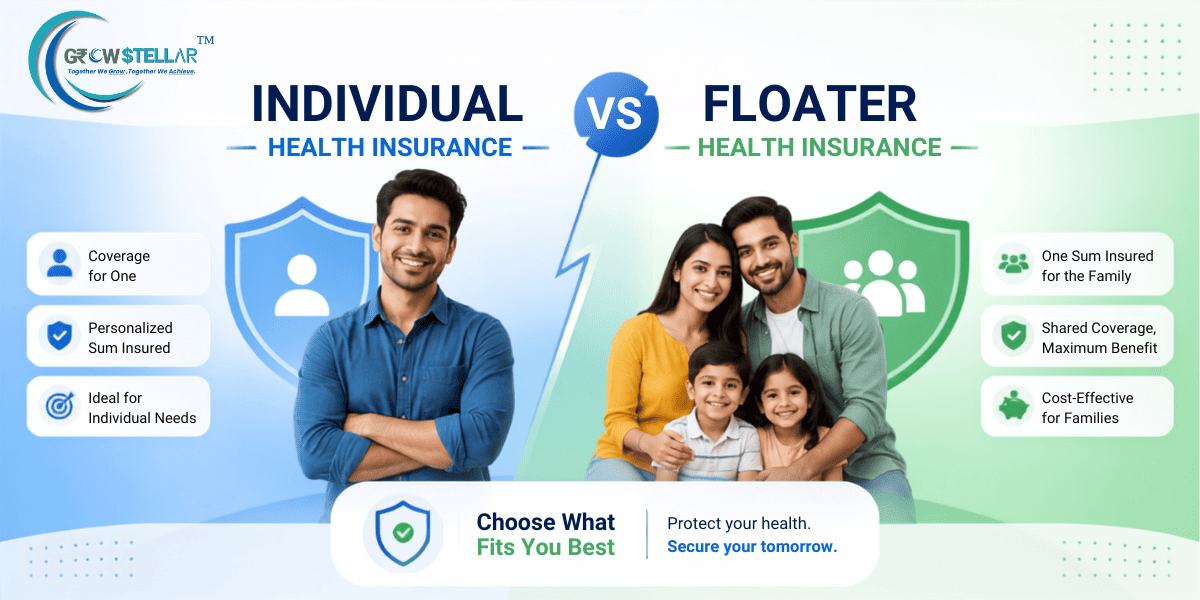
An individual insurance plan covers one person only. The entire sum insured is available for that one person’s medical needs.
This is better for people with known health conditions, senior citizens, or anyone who uses medical services frequently. Since the cover isn’t shared, there’s no risk of another family member using it up.
Family Floater Plan
A family floater covers your whole family under a single sum insured. It’s more affordable than buying separate plans for each member.
However, the cover is shared – if one person gets seriously ill and uses up the insured amount, other members are left with less or no cover for the rest of the year.
Best for young families where everyone is generally healthy and the chances of multiple big claims in one year are low.
What Does Health Insurance Cover?
| Category | What’s Covered |
|---|---|
| In-Patient Hospitalization | Room charges, ICU, doctor fees, nursing — minimum 24-hour admission |
| Pre-Hospitalization | Doctor visits, tests, medicines up to 30–90 days before admission |
| Post-Hospitalization | Follow-up consultations, medicines, tests after discharge (up to 60–180 days) |
| Day Care Treatments | Procedures like cataract, dialysis, chemotherapy — done under 24 hours |
| Domiciliary Treatment | Home-based treatment when hospital admission isn’t possible |
| Ambulance Charges | Road ambulance (and air ambulance on premium plans) |
| Organ Donor Expenses | Medical costs for the donor during organ transplant |
| AYUSH Treatment | Ayurveda, Yoga, Unani, Siddha, and Homeopathy (in licensed hospitals) |
| Mental Health Treatment | Psychiatric conditions and therapy (as per IRDAI mandate) |
| Modern Treatments | Robotic surgery, stem cell therapy, and other advanced procedures |
| Critical Illness (with rider) | Lump sum payout on diagnosis of cancer, heart attack, kidney failure, etc. |
| OPD (select plans) | Doctor visits and pharmacy costs without hospitalization |
What Is Not Covered?
| Category | What’s Excluded |
|---|---|
| Cosmetic Surgery | Nose jobs, liposuction, facelifts, or any surgery for beauty purposes |
| Self-Inflicted Injuries | Injuries from suicide attempts or deliberate harm |
| Drug & Alcohol Abuse | Hospital costs resulting from substance abuse |
| War & Terrorism Injuries | Injuries sustained during war, riots, or nuclear events |
| Pre-Existing Diseases (Initial Period) | Conditions you had before buying — covered only after waiting period ends |
| Dental & Vision (Routine) | Regular dental cleaning, glasses, and contact lenses — unless injury-related |
| Infertility Treatment | IVF, IUI, or any fertility-related procedures |
| Experimental Treatments | Unproven or non-standard medical treatments |
| Weight Loss Surgery | Bariatric surgery unless medically necessary (varies by plan) |
| Maternity (Base Plans) | Delivery costs usually need a separate add-on or rider |
| Congenital Diseases | Birth defects and genetic conditions (varies by policy) |
| Injuries from Dangerous Sports | Skydiving, bungee jumping, professional sports injuries |
Tips to Save Money on Medical Insurance Premiums
- Buy Early: Starting at age 25–30 locks in lower premiums before health risks increase with age.
- Go Annual: Paying the full year upfront is cheaper than monthly or quarterly instalments.
- Skip Unnecessary Riders: Add only riders you genuinely need — extras inflate costs without value.
- Maintain NCB: Stay healthy and avoid small claims to build your No Claim Bonus over the years.
- Compare Online: Always use comparison portals to check prices — don’t just go with the first quote.
- Choose Co-Pay Wisely: Opting for a small voluntary co-pay reduces your annual premium significantly.
Common Mistakes to Avoid When Buying Health Insurance
- Ignoring PED Terms: Not reading what counts as a pre-existing disease leads to nasty claim rejections later.
- Low Sum Insured: Choosing ₹3–5 lakhs cover for a metro family is almost always insufficient today.
- Skipping Restoration: Without a restore benefit, a single major illness can exhaust your cover for the year.
- Hiding Medical History: Not disclosing a condition to save money is fraud and will lead to claim denial.
- Only Checking Premium: The cheapest plan often has the most exclusions — compare features, not just price.
- Delaying Purchase: Every year you wait, your premium goes up and new conditions may make you ineligible.
Conclusion
Still questioning which plan is right for you? Here’s the truth – the best health insurance plan is the one that fits your real life, not just your budget.
If you’re young and healthy, start with a solid base plan and add riders as life changes. If you have a family or pre-existing conditions, invest in better coverage now – it will cost far less than a surprise hospital bill.
The seven plans we covered each have real strengths. No single plan is perfect for everyone.
So, are you going to let another year go by without the right cover? Or is today the day you finally protect yourself and your family the smart way?
Frequently Asked Questions
Q1. Can I buy Medical insurance for my parents above 70 years?
Yes. Many insurers now offer plans for seniors up to 80 years, though premiums are higher and some conditions may be excluded based on pre-existing health issues.
Q2. Is a medical test required before getting a insurance policy?
Yes, most insurers require a basic medical check-up for applicants above 45 years or when the sum insured crosses a certain threshold, usually ₹10–15 lakhs.
Q3. Can I have two insurance policies at the same time?
Yes. You can hold multiple policies and make claims from both. The Contribution Clause allows you to split claims across insurers without double-paying.
Q4. Does insurance cover COVID-19 and viral infections?
Yes. Since 2020, IRDAI mandated all standard health policies to cover COVID-19 hospitalization. Other viral infections are covered if hospitalization lasts over 24 hours.
Q5. Can I port my existing insurance to a new insurer?
Yes. IRDAI’s portability rules let you switch insurers without losing your accumulated waiting period benefits, provided you apply 45 days before renewal.
Q6. Is the premium paid for medical insurance eligible for tax deduction?
Yes. Under Section 80D of the Income Tax Act, you can claim deductions up to ₹25,000 per year for self and family, and ₹50,000 for senior citizen parents.